The intestinal barrier is one of the most important interfaces between our body and the outside world.
Every day it must distinguish between nutrients that should be absorbed, microbes that can safely remain within the intestine, and substances that potentially require an immune response.
When this carefully regulated system becomes disrupted, inflammation and intestinal permeability can increase.
For this reason, understanding how we maintain and restore gut barrier integrity has become an important area of research in inflammatory bowel disease.
One intriguing molecule attracting increasing scientific interest is Urolithin A — a compound created not directly by our bodies, but by our gut bacteria.
From Polyphenols to Urolithin A
Urolithin A demonstrates how closely nutrition and the microbiome are interconnected.
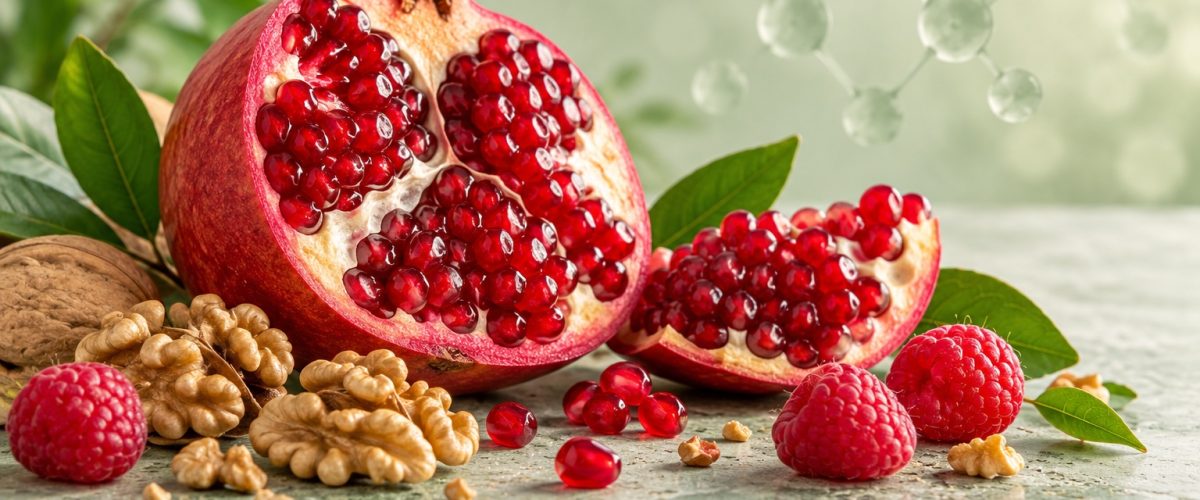
Foods including pomegranate, walnuts and certain berries contain plant polyphenols called ellagitannins and ellagic acid.
Humans don’t simply absorb all these compounds directly.
Instead, bacteria within the colon can metabolise them into a family of compounds called urolithins.
One of these microbial metabolites is Urolithin A.
Researchers are now investigating how Urolithin A interacts with intestinal epithelial cells and whether it could influence some of the pathways disrupted in inflammatory bowel disease.
Why the Gut Barrier Matters in IBD
The intestinal barrier isn’t simply a single wall.
It consists of several interacting defence systems including:
- Intestinal epithelial cells
- Tight junctions between those cells
- The protective mucus layer
- Immune cells
- Antimicrobial compounds
- The gut microbiome
Together, these systems allow the intestine to remain tolerant of food and beneficial microbes while still mounting an appropriate defence against pathogens.
In inflammatory bowel disease, aspects of this barrier and its immune regulation can become disrupted.
This can contribute to a cycle in which increased permeability, microbial signals and immune activation perpetuate intestinal inflammation.
A New Pathway for Gut Barrier Protection
Recent research has revealed a particularly interesting mechanism through which Urolithin A may influence the intestinal barrier.
Researchers found that Urolithin A can activate the aryl hydrocarbon receptor (AhR) within intestinal epithelial cells.
This subsequently activates a pathway involving:
NLRP6 → IL-18 → IL-22
Why does this matter?
These signals are involved in coordinating mucosal immune responses and maintaining the intestinal barrier.
The pathway was associated with increased production of mucin 2 (MUC2) and other protective molecules.
Why MUC2 Matters
The intestinal lining isn’t exposed directly to everything passing through the bowel.
It is protected by a layer of mucus.
MUC2 is one of the principal proteins forming this protective mucus barrier.
A healthy mucus layer helps maintain separation between intestinal bacteria and the epithelial cells beneath them.
When this protective system becomes compromised, microbes and microbial products can come into closer contact with the intestinal lining, potentially increasing immune activation.
The finding that Urolithin A influences pathways involved in MUC2 production therefore provides an interesting potential mechanism for its gut-barrier effects.
What Did Researchers Find in IBD?
One particularly interesting aspect of recent research is that investigators didn’t restrict their experiments entirely to animal models.
They also studied intestinal biopsies from people with inflammatory bowel disease.
Urolithin A increased IL-18 signalling in intestinal epithelial cells and IL-22 signalling in particular immune cells within these samples.
This gives researchers valuable evidence that the biological pathway identified experimentally is also present within human IBD tissue.
However, there is an important distinction.
Demonstrating a biological effect in intestinal tissue is not the same as demonstrating that Urolithin A treats IBD in people.
Clinical trials are needed before we can determine whether manipulating this pathway produces meaningful improvements in symptoms, inflammation or disease outcomes.
The Microbiome Adds Another Layer
There’s another complication.
We don’t all produce Urolithin A equally.
Researchers have identified several different urolithin metabotypes based upon how an individual’s microbiome metabolises ellagitannins.
Metabotype A predominantly produces Urolithin A.
Metabotype B produces Urolithin A alongside other urolithins.
Metabotype 0 may produce little or none of the final urolithins.
This means two people can consume exactly the same amount of pomegranate or walnuts but generate different microbial metabolites.
Why This Matters for Personalised Nutrition
This variability demonstrates one of the challenges — and opportunities — within personalised gut health.
We often ask:
“Is this food good for the gut?”
But a more sophisticated question might be:
“How does this person’s microbiome metabolise this food?”
The same dietary compound may produce different downstream metabolites depending upon the organisms present within the gut.
As microbiome science develops, these differences may eventually help us understand why individuals respond differently to dietary interventions.
What About IBS?
IBS and IBD are often grouped together because both affect the digestive system, but they are fundamentally different conditions.
IBD — Crohn’s disease and ulcerative colitis — involves chronic intestinal inflammation that can be objectively measured.
IBS is a disorder of gut–brain interaction characterised by symptoms including abdominal pain, bloating and altered bowel habits without the same pattern of tissue inflammation seen in IBD.
Gut barrier function is being investigated in both areas, but the current research around Urolithin A should not be interpreted as evidence that it treats IBS.
Should People With IBD Take Urolithin A?
At present, the research is better viewed as an exciting mechanistic discovery rather than a treatment recommendation.
People with Crohn’s disease or ulcerative colitis should not replace prescribed treatment with Urolithin A or other supplements.
The more interesting nutritional message concerns the relationship between polyphenol-rich foods and the microbiome.
Foods containing Urolithin A precursors include:
- Pomegranate
- Walnuts
- Pecans
- Raspberries
- Strawberries
- Blackberries
However, their benefits extend well beyond Urolithin A alone.
They provide fibre and numerous other plant compounds capable of interacting with the microbiome.
The Bigger Picture: Diet → Microbiome → Metabolites → Gut
Urolithin A illustrates an important change in the way we’re beginning to understand nutrition.
The relationship isn’t simply:
Food → Human
It can also be:
Food → Gut microbiome → Microbial metabolite → Human cells
Our microbes effectively act as biochemical factories, transforming components of our diet into new molecules.
Which molecules are produced depends partly upon which microbes we have.
That makes microbial diversity and personalised nutrition particularly interesting areas for future digestive-health research.
The Takeaway
Emerging research suggests Urolithin A can activate pathways involved in intestinal mucus production, mucosal immunity and gut barrier protection.
Recent findings involving IBD intestinal tissue make this an especially interesting avenue for future research.
But we’re not yet at the point where Urolithin A can be considered an established treatment for IBS or inflammatory bowel disease.
What it does provide is another compelling example of the extraordinary relationship between diet, our microbiome, intestinal immunity and gut barrier health.
And understanding that relationship may ultimately help us develop much more personalised approaches to digestive health.